
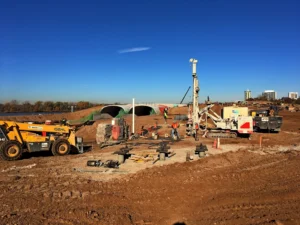
In specialty foundation construction, quality is measured not just by what is installed, but by how well it performs under real-world conditions. Because much of our work is concealed below grade, rigorous quality control and testing are essential to ensure that our systems meet design intent and provide long-term reliability. At FSGC, our commitment to precision, verification, and documentation sets the standard for dependable geostructural solutions.
Designing with Confidence—and Verifying in the Field
For pile design and installation, FSGC incorporates appropriate safety factors into our designs. When required by engineering submittals, we also verify pile capacity through field testing. This approach ensures that theoretical design assumptions align with actual site performance, reducing uncertainty and increasing confidence in the final product.
Specialty Foundations That Require Testing
Two key systems that commonly undergo testing in our work are:
- Micropiles
- Soil Nails
Both systems interact directly with variable subsurface conditions, making field verification a critical component of quality control.
Typical Testing Procedures
For micropiles, we perform either a proof test or a pre-production verification test based on project-specific engineering requirements. These tests may be conducted in either tension or compression, depending on the design criteria.
For soil nails, a percentage of installed nails—typically around 5%—are tested. The exact amount is determined by the project’s safety factor and engineering requirements.
Why Testing Is Essential
No two sites are exactly alike. Variations in soil conditions, groundwater, and installation variables can all impact performance. Field testing validates that the engineered design meets project requirements and provides assurance that the system will perform as intended, ultimately protecting the owner’s investment.
Step-by-Step Overview of Micropile Testing
Verification Test (Sacrificial Pile)
- The first pile is installed specifically for testing
- Grout is allowed to cure
- A hydraulic jack is set up for tension or compression loading
- The pile is loaded to at least 2 times the design load
- Creep (deflection) is measured and recorded over time
- The sacrificial pile is cut off and abandoned if required
Production Test (Active Piles)
- A series of production piles are installed
- Grout is allowed to cure
- A hydraulic jack is set up for testing
- The pile is loaded to 1.5 times the design load
- Creep is measured and documented
- If the test passes, the pile remains in place as part of the permanent system
Why Testing Matters to FSGC
Testing reflects our commitment to engineering integrity and our “do it right” philosophy. As a true design-build firm, we aim to build trust within the design and construction community by demonstrating transparency, accountability, and technical excellence.
Thorough documentation, reliable test results, and well-organized inspection records also ensure that our projects are audit-ready and defensible long after construction is complete.
The FSGC Standard
At FSGC, quality is more than compliance—it is a promise. Through careful design, disciplined installation, and rigorous testing, we deliver specialty foundation systems that perform with confidence, consistency, and reliability beneath the surface.