• Skip to main content
  • Skip to header right navigation
  • Skip to site footer

office@fsgeocon.com

(479) 927-0364

Download our Latest Brochure

Apply Now
Logo of Foundation Specialties featuring a stylized "FS" in gray and red, with the text "FOUNDATION SPECIALTIES" in gray and "GEOSTRUCTURAL CONSTRUCTION" in red below it.

Foundation Specialties Geostructural Construction

A Design-Build Deep Foundations & Support of Excavation Contractor

  • About
    • Our Team
  • Services
        • Specialty Deep Foundations
          • Micropiles
          • Helical Piles
          • Ductile Iron Pipe Piles
        • Ground and Rock Anchors
          • Ground Anchors
          • Rock Anchors
        • Structural Underpinning
          • Micropiles
          • Helical Piles
          • Steel Piers
        • Anchored Earth Retention / Support of Excavation (SOE)
          • Soil Nails
          • Tiebacks
        • Ground Improvement
          • Rigid Inclusions
  • Projects
  • Resources
    • Videos
    • Case Studies
    • Blog
  • Technical Briefings
  • Careers
  • Contact
Search
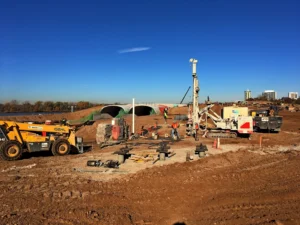
Construction site with machinery and workers on a clear day. Two large vehicles and a pile driver are operating on a dirt lot. Tunnels and city buildings are visible in the background. Orange cones and materials are scattered around.

Helical Piles vs. Micropiles: Choosing the Right Foundation System

September 18, 2026

Choosing between helical piles and micropiles isn’t about which system is faster or cheaper — it’s about what the ground can actually support. At FSGC, that decision always starts below the surface.

Reading the Ground First

Before anything else, we review the geotechnical report: soil type, depth to solid rock, groundwater, and how much load the foundation needs to carry. If there’s suitable clay and no shallow rock, helical piles are usually a strong fit. If rock sits close to the surface and the loads are heavy, micropiles tend to perform better.

Shallow rock is the biggest factor pushing a project toward micropiles. A helical pile works like a large screw — it gains strength by twisting into the ground until it reaches a target resistance, called torque. If rock is too shallow, the pile can’t reach that torque before it hits rock and stops advancing. Micropiles don’t have that limitation; they’re drilled directly into soil and rock and bonded in place with grout, so they perform reliably even where helical piles can’t get deep enough. In many of these cases, a hollow-bar micropile (a micropile that is installed by drilling and grouting in a single continuous process using a hollow steel bar) offers a fast, dependable way to reach competent rock without the need for a separate casing.

When Two Jobs Happen at Once

Some projects need underpinning and excavation support working together — holding up an existing structure while digging safely alongside it. We’ve handled this on a warehouse expansion, where the existing footing needed support before excavation could begin next door, and on a hospital project, where underpinning prevented settlement while soil was removed nearby — work that grew into a full shotcrete excavation wall, with micropiles tied in as soldier piles.

The building’s height and loading typically decide which system fits. A one-story structure with lighter loads can often use helical piles. A taller building next to a deep excavation usually calls for a cased micropile (a micropile installed with a permanent steel casing left in place for added stiffness and lateral resistance) instead, since it can carry the vertical load of the underpinning while also resisting the lateral pressure from the dig.

Where Helical Piles Add Real Value

When soil conditions cooperate, helical piles install quickly with minimal equipment, and once they reach the required torque, the foundation can be built immediately — no curing time, no extra testing. That speed can translate directly into savings on labor, equipment, and schedule, which is why it’s worth flagging a viable helical option even on projects where an engineer has already specified micropiles.

A Common Misconception

Helical piles are often assumed to be a drop-in substitute for micropiles. They aren’t. Where rock is shallow, they simply won’t reach the depth needed to perform — no matter how fast or economical they are elsewhere. When a client wants to save money with helical piles but the soil says otherwise, we explain what the ground is telling us, price both options honestly, and steer the conversation toward the system that will actually hold up over time — not just the cheapest one upfront.

The Bottom Line

Helical piles and micropiles aren’t rivals — they’re two tools built for different ground conditions. The right call starts with the geotechnical report, gets tested against the building’s loads, and only then factors in cost.

Have a project with tricky subsurface conditions? Loop our team in early — we’d rather help you land on the right system from day one.

Sidebar

Recent Posts

  • Helical Piles vs. Micropiles: Choosing the Right Foundation System
  • Employee Spotlight: From Day One to Year One
  • Quality Control in Specialty Geostructural Systems: How FSGC Delivers Confidence Below Grade
  • Why Safety Is Non Negotiable in Geostructural Construction
  • How Collaboration Between Engineers and Contractors Drive Project Success

Archives

  • September 2026
  • June 2026
  • April 2026
  • March 2026
  • February 2026
  • January 2026
  • December 2025
  • May 2025
  • January 2025
  • October 2022
  • September 2022
  • August 2022
  • July 2022
  • June 2022
  • April 2022

Categories

  • Blog

The Latest from Our Blog

Employee Spotlight: From Day One to Year One

Stephen Houser, Project Engineer This month we’re highlighting Stephen Houser as he celebrates his first year at FSGC and his first year in the field since graduating from Missouri S&T. Stephen joined as a Project Engineer in geostructural construction and has quickly grown into the hands-on …
Read moreEmployee Spotlight: From Day One to Year One

Quality Control in Specialty Geostructural Systems: How FSGC Delivers Confidence Below Grade

In specialty foundation construction, quality is measured not just by what is installed, but by how well it performs under real-world conditions. Because much of our work is concealed below grade, rigorous quality control and testing are essential to ensure that our systems meet design intent and …
Read moreQuality Control in Specialty Geostructural Systems: How FSGC Delivers Confidence Below Grade

Why Safety Is Non Negotiable in Geostructural Construction

Safety is foundational to everything we do in geostructural construction. The nature of our work—operating heavy, rotating equipment, working in tight spaces, and performing installations near open excavations—creates inherent risks that must be actively managed every day. At FSGC, safety is not a …
Read moreWhy Safety Is Non Negotiable in Geostructural Construction

Request A Technical Briefing

How Do They Work?

We look forward to the opportunity to meet your team and share our expertise in a lunch & learn format where we can deliver a seminar on any topic as it pertains to our field. 

Our briefings are approximately 45-60 minutes in length (depending on the number of questions).

Foundation Specialties will supply food and/or snacks for the attendees of these sessions and if interested, will provide a certificate for 1 PDH for any Professional Engineers on staff who attend these sessions.

Request A Technical Briefing

Get the Latest from FSGC

Stay up to date on company news, project progress, industry insights, and more.


Join Our Team!

We’re expanding our team of talented employees. Think you might be a good fit? Check out our current openings and submit your application now.

View Job Openings
  • Home
  • About
  • Services
  • Projects
  • Resources
  • Technical Briefings
  • Blog
  • Careers
  • Contact
  • Facebook
  • Instagram
  • LinkedIn
  • YouTube

Member of:

Logo of the Deep Foundations Institute featuring the letters "DFI" in bold red, with a downward arrow incorporated into the "I." The words "Deep Foundations Institute" arc above the letters in black text.
Logo of the ADSC: The International Association of Foundation Drilling, featuring large blue letters "ADSC" with a stylized drill in place of the letter "D.
Logo of Foundation Specialties featuring a stylized "FS" in gray and red, with the text "FOUNDATION SPECIALTIES" in gray and "GEOSTRUCTURAL CONSTRUCTION" in red below it.

881 Hatcher Rd
Springdale, AR 72764

(479) 927-0364
office@fsgeocon.com

Copyright © 2026 · Foundation Specialties Geostructural Construction · All Rights Reserved