• Skip to main content
  • Skip to header right navigation
  • Skip to site footer

office@fsgeocon.com

(479) 927-0364

Download our Latest Brochure

Apply Now
Logo of Foundation Specialties featuring a stylized "FS" in gray and red, with the text "FOUNDATION SPECIALTIES" in gray and "GEOSTRUCTURAL CONSTRUCTION" in red below it.

Foundation Specialties Geostructural Construction

A Design-Build Deep Foundations & Support of Excavation Contractor

  • About
    • Our Team
  • Services
        • Specialty Deep Foundations
          • Micropiles
          • Helical Piles
          • Ductile Iron Pipe Piles
        • Ground and Rock Anchors
          • Ground Anchors
          • Rock Anchors
        • Structural Underpinning
          • Micropiles
          • Helical Piles
          • Steel Piers
        • Anchored Earth Retention / Support of Excavation (SOE)
          • Soil Nails
          • Tiebacks
        • Ground Improvement
          • Rigid Inclusions
  • Projects
  • Resources
    • Videos
    • Case Studies
    • Blog
  • Technical Briefings
  • Careers
  • Contact
Search
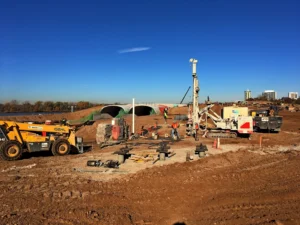
Construction site with machinery and workers on a clear day. Two large vehicles and a pile driver are operating on a dirt lot. Tunnels and city buildings are visible in the background. Orange cones and materials are scattered around.

Support of Excavation: Why What Happens Below the Surface Protects Everything Around It

October 7, 2026

It’s not about digging a hole — it’s about protecting everything the hole touches, from the workers inside it to the structures next to it.

Every excavation creates a problem the moment the first scoop of soil comes out: the ground that used to hold itself up now needs help. That’s the entire purpose of Support of Excavation (SOE) — sometimes called shoring. It’s the design of vertical and lateral support systems that keep an open excavation stable, sized to the actual risk a project carries, both now and later in its life.

Where SOE fits in the timeline

SOE work happens right before a deep excavation begins, and often continues in stages alongside it — partly to stay compliant with OSHA, partly to manage groundwater as the cut gets deeper. It’s not a separate phase tacked onto the schedule; it’s load-bearing infrastructure for the construction process itself.

There’s no “best” system — only the right one for the site

The right shoring system comes down to the project: the soil, whether the excavation is temporary or permanent, and whether materials can be pulled back out and reused. Reusable, removable systems are usually preferred, but sometimes shoring must stay in the ground permanently — either by design, or because removing it after backfill isn’t feasible.

Site conditions drive this decision too. The space around an excavation often determines whether it can be benched — cut back in steps — or needs full vertical support instead. Tight sites combined with low shear-strength soils call for a more robust shoring design, since there’s less room for error and less soil strength to lean on.

What’s actually at stake

Get SOE wrong, and the risk isn’t inconvenience — it’s collapse, injury, or worse to anyone working inside an active excavation. That’s why proper design and safety factors aren’t a formality; they’re the whole point.

Groundwater adds another layer. It changes the lateral load a system has to resist, which can reshape the final design. Just as important, it determines whether a dewatering plan needs to run alongside the shoring plan — because a shoring system and a wet excavation don’t mix well on their own.

Protecting what’s next door

SOE isn’t just about the hole — it’s about everything around it. A well-designed system prevents settlement in adjacent structures that sit at a higher elevation than the new excavation, especially where there’s surcharge loading from a building pressing down nearby. In some cases, that means underpinning an adjacent structure so even minor soil movement during shoring doesn’t translate into building settlement.

Permitting is part of the plan, not an afterthought

When a project requires a permit and a delegated shoring design, that design needs to be reviewed, approved, and possibly stamped by the engineer of record before permitting can move forward. We build this step into our process from the start, so it supports your timeline instead of becoming a bottleneck near the finish line.

Shoring is risk mitigation, not overdesign

It’s natural to look at a line item for shoring and wonder if it’s more than the project needs. In practice, every part of an SOE design is sized to a specific risk — the ones visible today, and the ones that could show up later if the ground shifts. Our job is to make sure you’re designing for the protection the site calls for.

We’re built to move fast when you need us to

Sometimes a shoring system needs surfaces later than anyone planned — maybe a GC is a week out from excavation and realizes they need support of excavation they hadn’t budgeted for. We can move quickly: a preliminary design, a bid to anchor the contract, materials ordered fast enough to mobilize. We’re glad to be that resource when timing gets tight.

But early is always better!

The smoothest projects are the ones where we’re looped in before the bid — with a geotechnical report in hand, so the risks and the budget for addressing them are clear from day one. If there’s excavation anywhere in your project’s future, bring us in early, and we’ll help you plan for it right from the start.

Sidebar

Recent Posts

  • Support of Excavation: Why What Happens Below the Surface Protects Everything Around It
  • Helical Piles vs. Micropiles: Choosing the Right Foundation System
  • Employee Spotlight: From Day One to Year One
  • Quality Control in Specialty Geostructural Systems: How FSGC Delivers Confidence Below Grade
  • Why Safety Is Non Negotiable in Geostructural Construction

Archives

  • October 2026
  • September 2026
  • June 2026
  • April 2026
  • March 2026
  • February 2026
  • January 2026
  • December 2025
  • May 2025
  • January 2025
  • October 2022
  • September 2022
  • August 2022
  • July 2022
  • June 2022
  • April 2022

Categories

  • Blog

The Latest from Our Blog

Helical Piles vs. Micropiles: Choosing the Right Foundation System

Choosing between helical piles and micropiles isn’t about which system is faster or cheaper — it’s about what the ground can actually support. At FSGC, that decision always starts below the surface. Reading the Ground First Before anything else, we review the geotechnical report: …
Read moreHelical Piles vs. Micropiles: Choosing the Right Foundation System

Employee Spotlight: From Day One to Year One

Stephen Houser, Project Engineer This month we’re highlighting Stephen Houser as he celebrates his first year at FSGC and his first year in the field since graduating from Missouri S&T. Stephen joined as a Project Engineer in geostructural construction and has quickly grown into the hands-on …
Read moreEmployee Spotlight: From Day One to Year One

Quality Control in Specialty Geostructural Systems: How FSGC Delivers Confidence Below Grade

In specialty foundation construction, quality is measured not just by what is installed, but by how well it performs under real-world conditions. Because much of our work is concealed below grade, rigorous quality control and testing are essential to ensure that our systems meet design intent and …
Read moreQuality Control in Specialty Geostructural Systems: How FSGC Delivers Confidence Below Grade

Request A Technical Briefing

How Do They Work?

We look forward to the opportunity to meet your team and share our expertise in a lunch & learn format where we can deliver a seminar on any topic as it pertains to our field. 

Our briefings are approximately 45-60 minutes in length (depending on the number of questions).

Foundation Specialties will supply food and/or snacks for the attendees of these sessions and if interested, will provide a certificate for 1 PDH for any Professional Engineers on staff who attend these sessions.

Request A Technical Briefing

Get the Latest from FSGC

Stay up to date on company news, project progress, industry insights, and more.


Join Our Team!

We’re expanding our team of talented employees. Think you might be a good fit? Check out our current openings and submit your application now.

View Job Openings
  • Home
  • About
  • Services
  • Projects
  • Resources
  • Technical Briefings
  • Blog
  • Careers
  • Contact
  • Facebook
  • Instagram
  • LinkedIn
  • YouTube

Member of:

Logo of the Deep Foundations Institute featuring the letters "DFI" in bold red, with a downward arrow incorporated into the "I." The words "Deep Foundations Institute" arc above the letters in black text.
Logo of the ADSC: The International Association of Foundation Drilling, featuring large blue letters "ADSC" with a stylized drill in place of the letter "D.
Logo of Foundation Specialties featuring a stylized "FS" in gray and red, with the text "FOUNDATION SPECIALTIES" in gray and "GEOSTRUCTURAL CONSTRUCTION" in red below it.

881 Hatcher Rd
Springdale, AR 72764

(479) 927-0364
office@fsgeocon.com

Copyright © 2026 · Foundation Specialties Geostructural Construction · All Rights Reserved